
Tour review · HISTORICAL TOURS
Venice: Entrance Ticket to the Naval Historical Museum
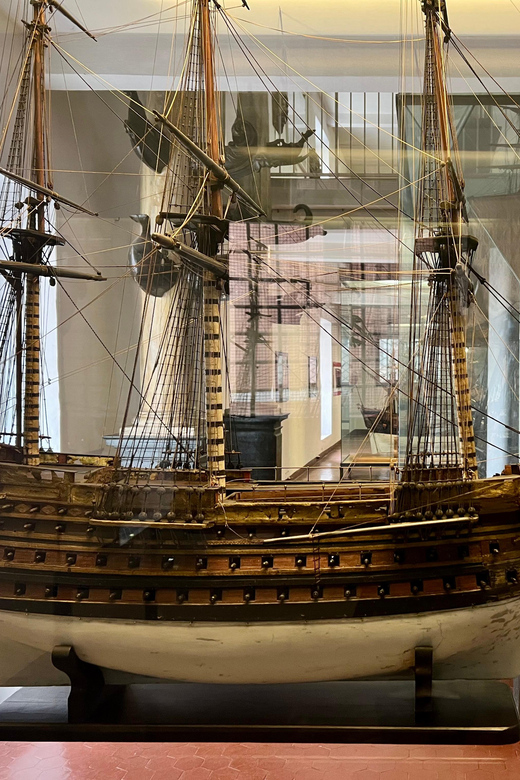
If you like ships, this hits the spot. The Naval Historical Museum (MUNAV) is a smart 1.5-hour walk through Venetian and Italian Navy life, from early boats to modern models, plus an exceptional set of vessels from China and the Far East. I love the ship models and artifacts that make the story feel practical, and I also like the museum’s setting, a 15th-century granary tied to the Serenissima’s maritime power. One possible drawback: it is self-guided, so you will want to slow down and read, or bring curiosity about naval terms.
This museum sits about a five-minute walk from Piazza San Marco and right by the Ancient Arsenal, so you can line it up with the rest of your day without long detours. The building is large too, around 6,000 square meters across five floors, which means you will see a lot, but you should plan your pace. At $18 per person, it is not a bargain ticket, but it can feel like good value in Venice if you focus on the exhibits instead of trying to rush everything.
Key points to know before you go
- Skip-the-line with a separate entrance, which helps a lot in busy Venice.
- Five floors in a 15th-century granary, tied directly to the Serenissima’s maritime world.
- Venetian origins through modern Italian Navy, so you get a full timeline in one stop.
- Ship models, paintings, and documents, not just one type of display.
- A standout collection of boats from China and the Far East, a contrast from the usual Mediterranean focus.
MUNAV at a Glance: what a 1.5-hour ticket really covers
MUNAV is the Naval Historical Museum of Venice, and it is exactly the kind of place that rewards you for having even a little interest in boats and sea power. With an entry ticket and no guided tour included, you control the pace. If you only do the highlights in 60 to 90 minutes, you still walk away with a clear sense of what the Venetian maritime tradition looked like over time.
The museum is built for that “time travel” feeling. You are in a 15th-century building that once served as a granary for the Serenissima Republic, which means the space itself comes from a period when Venice ran on trade and fleets. The exhibits then stretch across centuries and themes, moving from ancient Venetian boats to modern Italian Navy models. You also get ship models plus paintings and documents, so it is not just pretty displays. It is written history turned visual.
At $18 per person, the value depends on what you want out of Venice. If you are sightseeing by vibes alone, you might feel it is pricier than the typical quick stop. If you like museums that show how things worked, how ships evolved, and what sailors actually carried, this can be one of your better buys for the day.
A few more Venice tours and experiences worth a look



San Marco to the Arsenal: finding the museum with less stress
Location is where this ticket quietly wins. The museum is only about a five-minute walk from Piazza San Marco, and it is adjacent to the Ancient Arsenal of Venice. That matters because it lets you stitch it into a practical route. You do not have to cross the city just for one museum block, and you can pair it with Arsenal-area sights you may already be walking past.
If you are planning around crowds, use the skip-the-line entrance. Even if you arrive at a normal time, Venice can turn into a slow crawl at ticket lines. Having a separate entrance helps you spend more time inside and less time standing still.
Also, since this is self-guided, you do not need to coordinate with a group schedule. Your main timing is simply your chosen entry time and how fast you move between floors.
Inside the 15th-century granary: five floors, lots of material
MUNAV covers about 6,000 square meters across five exhibition floors. That layout is a double-edged sword. Good news: you can stay busy without feeling like you saw everything in five minutes. Bad news: if you are the type who tries to do everything on one pass, you may end up tired on the staircases and skim key items.
So I suggest a simple approach. Pick a theme for each floor. For example, you can aim for “Venice early maritime life” on one level, “ship technology and models” on another, and “later era and modern Navy” on a third. Even if you do not stick perfectly to a plan, having one helps you avoid the classic museum problem where you drift and remember nothing.
The museum’s setting also gives you a better sense of what the artifacts meant. The building’s original role as storage links to how Venice functioned: food, supplies, and goods had to be stored, moved, and protected, and ships were the vehicle for all of it. You are basically viewing nautical history inside a structure built for logistics.
Venetian boats to modern Italian Navy models: the timeline you can track
One of the most satisfying parts of MUNAV is the range. You start with early Venetian boats and then move toward contemporary Italian Navy models. That creates a timeline you can actually follow, rather than a random set of unrelated displays.
The museum includes historical artifacts, ship models, paintings, and documents. In practice, that means you are not only seeing the shape of ships. You are also learning what people believed, recorded, and valued. Documents can make the story feel more grounded. Paintings can show how Venetians imagined their maritime world, including the human side of sea power.
On the “modern” side, Italian Navy models help you see continuity. Ships do not just change because engineers get bored. They evolve because missions, materials, and strategy evolve. You start noticing that the museum is really about maritime tradition as a working system, not just a collection of old boats.
The China and Far East boat collection: the surprising contrast
If you want one “wow” moment that breaks up the usual Venice-only focus, look for the exceptional collection of boats from China and the Far East. This is not a small footnote. It is highlighted as a key part of the museum’s offerings, and it creates a useful contrast.
Why it matters: once you see how different maritime cultures built and used boats, you understand that seafaring was not just a Mediterranean story. It was a worldwide set of solutions. Even when you do not know every technical term on a label, you can compare shapes and build choices.
This section is also a great reminder that Venice did not live in a bubble. As a maritime hub, it traded widely. The presence of Far East craft in a Venetian naval museum helps you connect the dots between commerce, knowledge transfer, and how ship design ideas travel.
My advice: slow down here. This is the kind of exhibit where 10 extra minutes of looking at the details can make the whole visit feel smarter.
You can also read our reviews of more historical tours in Venice






Ship models, paintings, and documents: how to read what you see
Most naval museums can be either too technical or too vague. MUNAV does better than average because it mixes formats. Ship models show structure. Paintings add mood and context. Documents give you names, dates, and a paper trail that makes the whole thing feel less like a museum diorama.
When you are doing this on your own, you need a method. Try scanning each display for three things:
- What object is it, exactly?
- What era or region is it tied to?
- What story element is emphasized, like trade, navigation, defense, or exploration?
If the labels are text-heavy, do not punish yourself. Read the one or two sentences that seem most direct, then look at the object again. You will usually start spotting the features the text is pointing to. That is how you avoid the “I looked but I did not learn” museum trap.
Also, the museum is spread across five floors. If you start with the heaviest documents first, you might burn out early. A lighter order can work better: start with models and paintings, then take the documents when you feel ready to focus.
Pricing and value: is $18 worth it in Venice?
$18 per person for an entry ticket is not the cheapest thing in Venice. But value in Venice is not only about the lowest price. It is about time, access, and how much you get for your effort.
Here is the value math that makes sense for this museum:
- Duration is about 1.5 hours, which is a solid chunk of indoor time when you want a break from crowds.
- Skip-the-line through a separate entrance helps you convert your ticket into museum time, not queue time.
- The content range is broad: Venetian origins, modern Italian Navy models, ship models, paintings, and documents, plus Far East boat collections.
If you enjoy maritime themes, this ticket can feel fairly priced because you are paying for access to a large, multi-floor collection rather than a small room of highlights. If you are not into boats at all, you might feel the price more sharply, because the exhibits are the whole point.
How to plan your visit: timing, pacing, and ticket flow
This experience is simple on paper: check availability for starting times, reserve your spot, then pay later if that option is available to you at checkout. It also offers free cancellation up to 24 hours in advance for a full refund, which is helpful in Venice when weather and crowds can change your plan quickly.
Because your visit is self-guided, starting times matter less than how you move through floors. If you are trying to protect your energy, choose an entry time when you can walk calmly from San Marco area. The museum is close, but you will still want a plan for water breaks and shoes.
For pacing, do not try to “finish” every floor like a checklist. Instead, aim for the major sections and then circle back if you have energy. A good strategy is to take one slow pass on each floor for the first half of your visit, then spend the last quarter hour focusing on your favorite type of display, usually the ship models.
Also, pack the reality that this is a real museum in a large building. If you come in expecting a quick glance, you might miss the detail that makes it worth your time.
Who this fits best, and who might want to skip
This ticket fits best if you:
- Like ships, models, maritime artifacts, or naval-themed museums
- Want a change from the usual art and church route around San Marco
- Enjoy when museums mix objects with context like documents and paintings
It is less ideal if you:
- Want a guided explanation and do not like reading labels
- Are short on time and only want quick, surface-level stops
- Prefer fully interactive experiences, since this is display-focused
If you are traveling as a couple or solo, self-guided is often a plus. You can linger where your interest pulls you, especially around the Far East boat collection and the timeline from Venetian to modern Italian Navy models.
Should you book this Venice Naval Historical Museum ticket?
I would book it if you want a structured, indoor Venetian experience that connects the city to its maritime power. The setting alone helps, the museum is near San Marco and adjacent to the Ancient Arsenal, and the exhibit mix gives you multiple ways to learn, models, paintings, and documents. The skip-the-line entrance also improves your odds of actually enjoying your visit instead of spending your hour in a queue.
Skip it if you only want the biggest-name sights and do not care about naval themes. At $18, you want to be the kind of visitor who will notice details on the exhibits, not just walk through.
If that sounds like you, this is a strong use of 1.5 hours in Venice.
FAQ
How long does the Naval Historical Museum visit take?
The entry ticket is listed with a duration of about 1.5 hours.
Where is the museum located?
It is in Venice, Veneto, Italy, about a five-minute walk from Piazza San Marco, and adjacent to the Ancient Arsenal of Venice.
What is included with the ticket?
Your ticket includes entry to the museum.
Is a guided tour included?
No, a guided tour is not included.
Is there a way to avoid the line?
Yes. You can skip the line through a separate entrance.
How much does it cost?
The price is $18 per person.
Can I cancel and get a refund?
Yes. Free cancellation is available up to 24 hours in advance for a full refund.
Can I reserve now and pay later?
Yes. The option is available to reserve your spot and pay later.
Are there starting times to choose from?
Yes. You need to check availability to see starting times.
Are pets allowed inside?
Small pets are allowed in rooms and outdoor spaces if they are carried in their own carrier or in arms for the duration of the visit. Guide dogs are exempt.
Is the museum self-guided?
The ticket does not include a guided tour, so you will explore at your own pace.
More Historical Tours in Venice

More Tickets in Venice



More Tour Reviews in Venice




Not for you? Here's more nearby things to do in Venice we have reviewed











Historical Tours, compared.
 ★ 3.9St. Mark Basilica Ticket, Audioguide+History GalleryFrom $234,780 reviews
 ★ 4.5Venice’s Best: Basilica, Doge’s Palace, Gondola & History GalleryFrom $1292,478 reviews
 ★ 4.2City Center Historical Guided Walking TourFrom $141,873 reviews
 ★ 4.3Bell Tower & St Mark’s Square History Gallery TicketFrom $44910 reviews
 ★ 5.0Basilica, Doge’s Palace, History Gallery & Bell Tower OptionFrom $116586 reviews
 ★ 4.7Natural History Museum Entry TicketFrom $11312 reviews
 ★ 3.5St. Mark’s Cathedral Priority Guided Tour & History GalleryFrom $33148 reviews
 ★ 4.8Venice, Submarine Enrico Dandolo and Naval History MuseumFrom $30109 reviews
Browse the lists this tour appears in