
Tour review · AUDIO TOURS
The Heart of Venice: A Self-Guided Audio Tour
One square can teach you a whole city. This self-guided GPS audio tour lets you roam at your pace while the route auto-plays audio as you reach each landmark, with stories that connect the big famous places to the lived details of Venice. I like the mix of iconic sights and smaller, story-driven stops, and I also like that you get offline access so the app can work even when service is spotty.
The trade-off: you need to bring your own smartphone and use the VoiceMap app, so you are doing the navigation yourself (just with helpful GPS cues). If you want a fully interactive, turn-by-turn human guide, this is not that. It is a smooth, independent walk with an audio guide that keeps you on track.
If you are staying in the historic center and want an efficient way to get oriented, this route makes sense. It runs about 1 hour from Piazza San Marco to Rialto Bridge, and it includes lifetime access to the tour after purchase.
Key highlights you will feel right away
- Auto-playing audio at each spot keeps you moving without constantly tapping buttons
- Offline maps and geodata mean no relying on data once you are on the move
- A tight route from San Marco to Rialto fits a short visit without cramming too much
- Stories behind the landmarks turn postcard Venice into something you can actually remember
- VoiceMap directions to the start help you get going even if you are new to the area
Piazza San Marco, the Piazza where everything happens
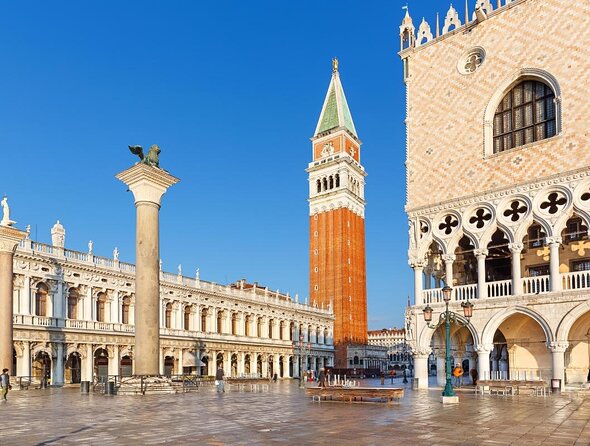
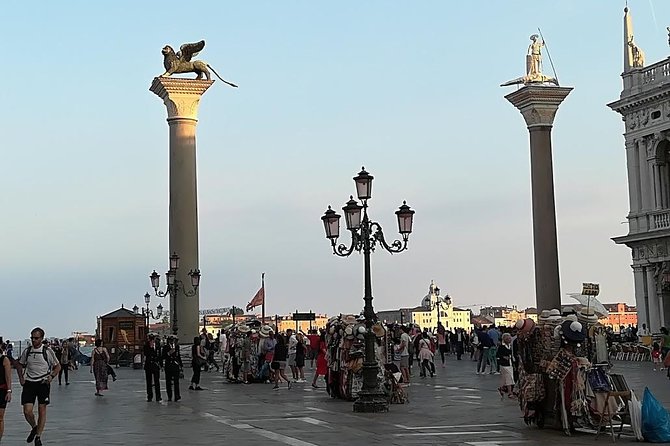
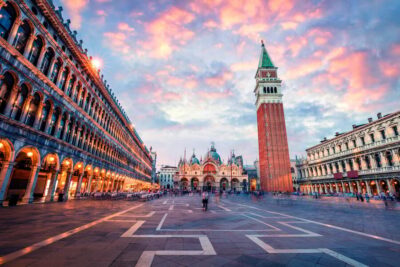
Most people arrive at Venice through Piazza San Marco. It is central, famous, and so packed with meaning that even the ground you stand on feels watched by history. In this tour, you start right in that power zone at P.za San Marco, 328, 30124 Venezia VE, Italy.
I love starting here because the audio does a smart job of setting the tone fast. You do not just get a list of sights. You get the Piazza as the city’s social stage, with a feel for why people from centuries ago kept coming back. You hear how it was once called the drawing room of Europe, while Venetians simply call it the Piazza, and you also hear about the kinds of dramatic public moments that took place there: state visits, religious processions, public executions, and Carnival.
Practical tip: this is a huge square. Your first minutes can feel like sensory overload, especially if you are also dealing with crowds. The payoff of the audio tour is that it gives you a handle on what to notice while you are standing there.
Potential drawback: because the area is so famous, you may not get quiet, slow photo breaks. Plan to move with purpose. Use your audio moments as time markers instead of trying to stop every time you see something.
You can also read our reviews of more guided tours in Venice

Campo San Salvador and the 1898 column tied to 1848 revolt
Next comes Campo San Salvador, a square that feels more local and less tourist headline. The centerpiece here is a tall marble column, set up in 1898, commemorating the Venetian revolt against Austrian occupation in 1848 and 1849.
This stop is valuable because it shows you a different Venice than the marble and mosaics spotlight. It is about civic memory, about how public spaces become archives. Even if you only catch a few minutes of the story while you are walking, it changes how you read what you see. A column is no longer just decoration. It is a marker of resistance and identity.
What you should do: don’t speed past it. Take a moment to locate the column, then let the audio explain what it is standing for. Campo San Salvador also gives you a breather before you hit the larger cultural sites.
Possible consideration: like many Venetian squares, it can be narrow on approach. If you are traveling at peak time, expect slower movement. Your best strategy is to trust the route and keep your pace steady.
Teatro Comunale Carlo Goldoni, where comedy became real people
From the open square, the tour shifts into Venice’s storytelling side. You head to Teatro Comunale Carlo Goldoni, named for Carlo Goldoni, a Venetian playwright from the 1700s.
The audio here focuses on why Goldoni mattered. He wrote many comedies in the Venetian dialect, and that was revolutionary for his time. The key idea you learn is that he made his characters seem like real people, highlighting the quirks of ordinary Venetians in a way that felt new.
I like this stop because it reminds you that Venice was not only built by nobles and merchants. It was also built by everyday culture, language, and theater habits. Even if you do not catch a performance, the building and the name give you a cultural anchor.
Practical tip: when the audio switches to this stop, it is a good time to slow down and pay attention to the dialect angle. It is one of those details that helps you stop thinking of Venice as a single museum experience.
Potential drawback: if you are mostly interested in architecture and less in cultural history, this may feel lighter than the bigger landmark stops. Still, it is short and story-rich.
La Fenice opera stories, from Rigoletto to La Traviata
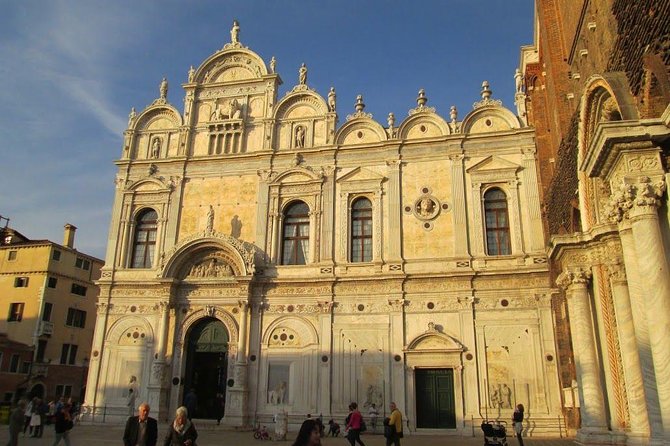
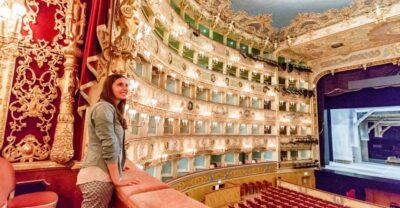
Then you reach La Fenice, one of Italy’s most important opera houses. The tour connects it directly to major opera premieres, including Rigoletto and La Traviata.
This is where the audio becomes extra fun if you like the idea of tracing creative “firsts.” Venice is not just a backdrop. It was a stage for major works that went on to become widely known later. Learning that these famous operas had their first performance at La Fenice helps you see the building as a living part of European culture, not just a historic facade.
What to notice: because this is an opera house, the atmosphere around it can feel more formal than the squares you just walked through. Let that shift land. The best use of this stop is to imagine the performances when the story plays, even if you are just passing by.
Possible consideration: if you are hoping for an interior visit, the tour information you have here focuses on the audio route and landmark stops, not on admissions. If you want to go inside, you would need to handle that separately.
Palazzo Cavalli and the Tide Center behind acqua alta
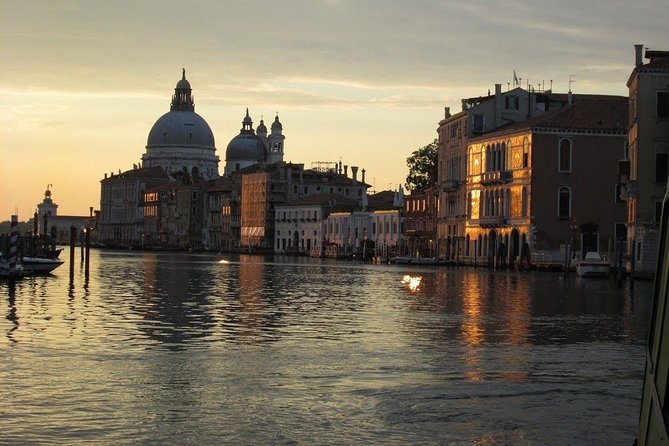
Palazzo Cavalli enters the tour with a completely different kind of Venice: science, monitoring, and daily planning for acqua alta. You learn that Palazzo Cavalli houses civil marriage services, and it also houses the Centro Maree, or Tide Center.
This is where the tour gets unexpectedly practical. The Centro Maree is where tide and weather data is monitored, and it is where daily predictions are made, especially predictions for high tide, acqua alta.
I really like this stop because it breaks the cliché of Venice as only romantic and decorative. Venice is engineering and adaptation too. When you hear that predictions are generated daily, you start to understand why the city has so many coping strategies for flooding and why the topic comes up so often.
Practical tip: if you are visiting during a season when acqua alta can be an issue, this is the story you want in your head. Even without changing your plans, it gives you context for what you might see around you.
Potential drawback: if you are not interested in environmental systems or weather, it may feel less emotionally dramatic than a theater or bridge. The upside is that it makes your Venice feel more real.
A few more Venice tours and experiences worth a look




Rialto Bridge, the third bridge and why it matters
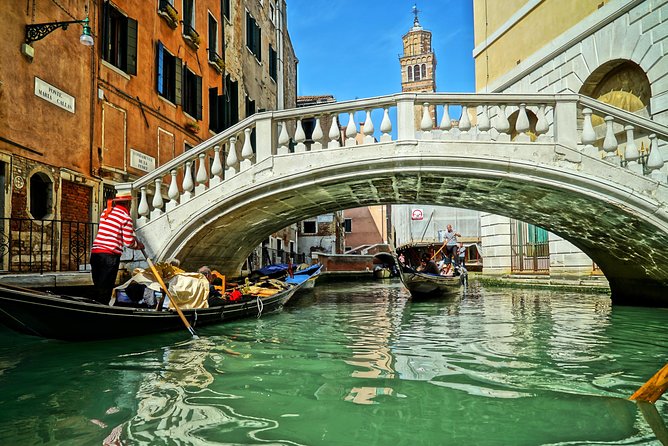
The route ends at Rialto Bridge, at Ponte de Rialto, 30100 Venezia VE. This is Venice’s classic crossing, and the audio gives you a smart historical angle: it is the third bridge of its kind.
Earlier Rialto bridges were made of wood, and they were bascule bridges. That means the center part could be raised to let ships with masts pass through.
This explanation does more than add trivia. It helps you connect the bridge to the real working rhythm of Venice. In a city where waterways are streets, bridges have to do more than look good. They have to function for boats and commerce.
What to do at the end: stand at a viewpoint, look at the water traffic if you can, and let the “bridge evolution” story sink in. Then decide where you want to go next on your own. This is a good end point because it drops you right into the historic center’s flow.
Possible consideration: Rialto is busy. If you are trying to take photos without stopping for long, keep moving. Your audio is done by the end, so you can switch from listening mode to wandering mode.
Offline VoiceMap, one phone you will need, and how to use it well
This tour runs through the VoiceMap Audio Tours app. The big help is that the audio plays automatically when you reach each spot. That matters because it reduces decision-making while you are walking in a complicated place.
You also get offline access to audio, maps, and geodata. Translation: you can plan and start with less stress about data coverage. In Venice, that can make the difference between a smooth walk and constant reconnect attempts.
Here is the practical checklist you should follow:
- Bring your own smartphone (not included)
- Use the VoiceMap application
- Download or prepare for offline access before you start, so the offline features are ready
- Listen for the auto-trigger points and keep your pace consistent with the route
Another detail I appreciate is the directions to the starting point. Venice navigation can be tricky when you are bouncing between squares and streets. Having a clear start helps you avoid wasting the first part of your hour getting oriented.
Language note: the tour is offered in English.
Timing and value: $11.99 for a focused Venice orientation walk
The price is $11.99 per person, and the duration is about 1 hour. For Venice, that is a pretty strong value, mainly because you are paying for time efficiency. You get an audio guide that leads you through meaningful stops without paying for a longer guided tour.
It also includes lifetime access to the tour. That is useful if:
- you want to repeat the walk later with fresh eyes,
- you have friends who come visit and you want them to use the same route,
- you prefer doing a short “first pass” now and a deeper look another day.
One more value factor is flexibility. Because it is self-guided, you can linger where the story grabs you and you can skip ahead if you are tired or caught in a crowd. In a city like Venice, that kind of control matters.
If you only have one short window and you want to leave with more than photos, this route gives you a narrative. It is not trying to cover everything. It focuses your attention on the core Venice spine from San Marco to Rialto.
Should you book The Heart of Venice self-guided audio tour?
I would book this if you want:
- a short, high-impact Venice walk,
- audio stories that explain why each landmark matters,
- an independent route where you can set your own pace,
- offline support so you are not stuck when data is unreliable.
I would skip it if you strongly prefer:
- a live guide who answers questions and adapts to your interests,
- an indoor-heavy itinerary with admissions included (this tour information does not promise entry tickets),
- a hands-off experience where you do not use a phone at all.
If you are a first-timer in Venice, this is an especially good match because the landmarks are famous, and the stories help you understand what you are seeing without needing a full day.
FAQ
How long is The Heart of Venice self-guided audio tour?
The tour is approximately 1 hour.
Does it work offline?
Yes. It includes offline access to audio, maps, and geodata, so you do not need data during the tour.
What language is the audio tour available in?
The tour is offered in English.
Do I need to bring a smartphone?
Yes. A smartphone is not included, and the tour uses the VoiceMap application.
Where does the tour start and end?
It starts at Piazza San Marco (P.za San Marco, 328, 30124 Venezia VE) and ends at Rialto Bridge (Ponte de Rialto, 30100 Venezia VE).
Is there an access fee on some dates?
On certain dates, day visitors staying outside of Venice may be required to pay a €5 access fee. You can check applicable days and exemptions at https://cda.ve.it.
More Guided Tours in Venice



More Tours in Venice




More Tour Reviews in Venice


Not for you? Here's more nearby things to do in Venice we have reviewed










Audio Tours, compared.
 ★ 4.6La Fenice Opera House Entry Ticket with Audio GuideFrom $1411,742 reviews
 ★ 3.4St. Mark’s Basilica Ticket with Audio GuideFrom $361,645 reviews
 ★ 3.9Gondola Tour under the Bridge of Sighs & Audio GuideFrom $42617 reviews
 ★ 3.9Gondola Ride with Live Guide or Audio GuideFrom $42472 reviews
 ★ 3.2St. Mark’s Basilica Priority Ticket and Audio GuideFrom $34230 reviews
 ★ 4.3Explore San Giorgio Island with Ticket & Audio GuideFrom $17228 reviews
 ★ 3.7Jewish Ghetto and Synagogue Ticket with Audio GuideFrom $1654 reviews
 ★ 4.2Saint Mark Basilica Priority Access & Audio Guide OptionFrom $3653 reviews
Browse the lists this tour appears in