
Tour review · CYCLING TOURS
Lido Bike Tour: With a Local on the Island of Cinema
Lido feels like a secret. This Lido di Venezia bike tour with deTourist Venice guide Valerio Coppo is a smart, car-light way to see Venice’s cinema links, beaches, and lagoon islands in about 4.5 hours.
I especially love the mix of big-name Venice culture and real local texture. You get film-festival connections tied to the Grand Hotel des Bains and the Palazzo del Cinema area, and you also ride through quieter parts of the island where the pace feels more like a day trip than a sightseeing sprint.
I also like how the route keeps you moving with purpose, not stuck in traffic, and how bike choices let you match your comfort level.
One drawback to plan for: the tour price is for the guided experience, and the bike itself costs extra. Also, parts of the ride can be a little rough or sandy, so if you hate bumps, consider asking for wider tires.
Key highlights you’ll feel right away
- Small-group ride with a max of 10 travelers, so your guide can adjust to your pace
- Film festival and hotel cues connected to places linked with the Mostra and classic movies
- A quieter Lido loop that uses canals and protected natural areas, away from the busiest road vibe
- Beaches plus engineering at Murazzi, the breakwater that still matters
- Quarantine and former hospital islands like Poveglia and Lazzaretto Vecchio
- Local village time in Malamocco, with canals and calli that feel small and real
Why Lido by bike beats Venice on foot
Venice’s main islands can feel like an endless crowd shuffle. Lido is different. Once you roll onto the island, the feel changes fast: more sea air, more space, and lots of stretches where the only noise is your tires on the path.
This tour is built around that change in rhythm. You’re not just seeing random points on a map. You’re getting a guided “route brain,” so the film festival landmarks, old cemeteries, lighthouses, and beaches start to make sense as one story across the island.
And that matters for value. You spend your energy riding, not searching. With a guide, you get the fast route to the stuff that’s actually worth your time on Lido, plus the context that turns it from postcard to place.
You can also read our reviews of more cycling tours in Venice


Starting at Santa Maria Elisabetta and picking the right bike
You meet at Santa Maria Elisabetta on Lido. From there, the bike rental is handled for you, so you’re not stuck waiting while everyone else figures out paperwork.
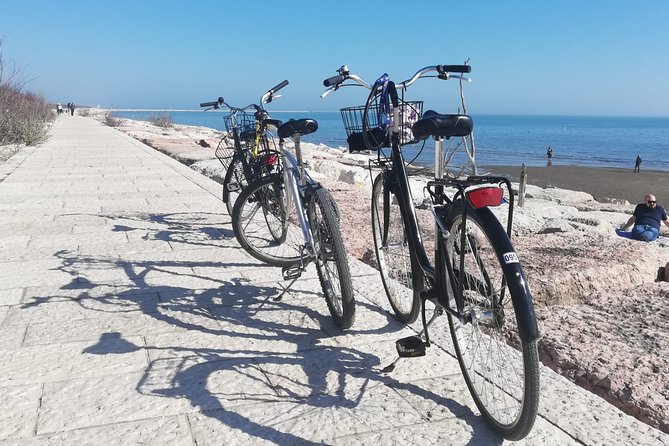
Here’s your key decision: the tour is set up so you choose your ride style, and the bike is booked in advance for you. Options include a city bike (10 euros), tandem (20 euros), e-bike (20 euros), fat bike (18 euros), and e-fat bike (30 euros). If you’re coming from a hilly city and want a manageable day, an e-bike is a straightforward comfort upgrade.
One practical tip from real-world experience: even on an island meant for leisurely movement, you can hit sandy patches and rough bits of path. If you want an easier ride over those sections, ask for wider tires for the same route. It can turn a “we’ll probably walk this” moment into a smooth pedal.
Jewish cemetery peace: Cimitero Ebraico on Lido
The first meaningful stop is the Cimitero Ebraico. Today it feels like a quiet garden, but this was Venice’s main Jewish cemetery from 1386 until the 18th century.
What I like here is the contrast. You start the ride with an island landmark that isn’t about romance or movie posters. You’re meeting Venice’s darker, quieter chapters in a place that doesn’t demand attention, it simply holds it.
From the gate, you can see ancient tombs with different design styles, including Venetian gothic and Ottoman influences. That visual mix is exactly the kind of detail that works better with a guide than with a quick glance from the bike seat.
San Nicolò al Lido: the sea ritual connection
Next comes Chiesa di San Nicolo al Lido. This is where the traditional thanksgiving mass of the Sposalizio del Mare, the Marriage of the Sea ceremony, is performed.
This stop gives you a key to understanding Venice’s relationship with water that’s more than touristy. Venice has always treated the sea as both provider and force to manage. A religious ceremony like this used to symbolize maritime dominion, and that idea still echoes in how Venice sees its lagoon world.
Even if you don’t linger long inside, you’ll get enough explanation to connect it to the rest of your ride: lighthouse views, harbor edges, canals, and the islands used for quarantine and isolation later on.
Faro di San Nicolò: lighthouse views without the traffic grind
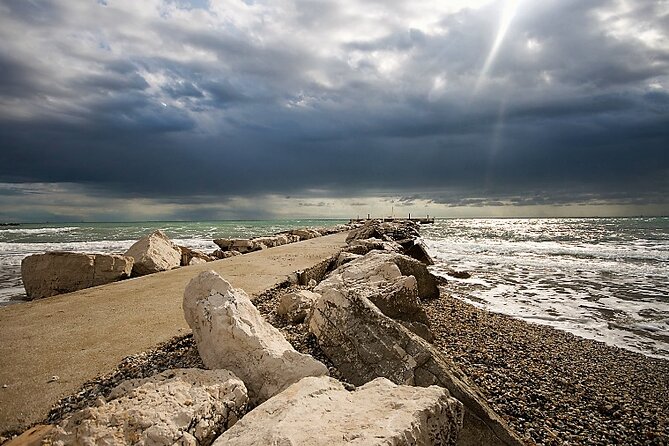
Then you bike to Faro di San Nicolò. This part of the route is set up so you keep moving after the church stop, riding through a protected natural zone before you continue along an old pier between the sea and the harbor mouth.
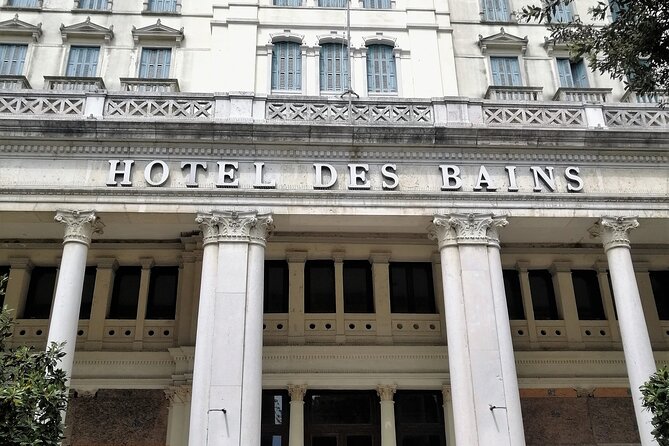
The payoff is the coastline view. From here you can appreciate the outlines of the Grand Hotel des Bains and Hotel Excelsior area, which are important later when you connect Lido’s cinema history to physical places.
This is also a good time to adjust your expectation: Lido isn’t one grand scenic overlook. It’s a chain of small views that add up. The lighthouse stop helps you “read” what you’re seeing as you head toward the hotel corridor.

Grand Hotel des Bains: luxury past and movie gravity
Grand Hotel des Bains is one of those places that feels like it has a built-in story engine. It was a former luxury hotel built in 1900 to attract wealthy tourists.
It’s also remembered for Thomas Mann’s stay in 1911 and for movie settings, including Death in Venice by Visconti (1971) and The English Patient (1996). Even if you’re not a film buff, you’ll feel the weight of it when you’re physically near the building, because the architecture carries that early-1900s confidence.
The guide’s value here is interpretation. You’re not just hearing facts. You’re connecting them to what Lido became: a place where the wealthy and the creative flocked to be seen, and where the sea air met high culture.
Ristorante Mostra del Cinema and the Palazzo del Cinema vibe
Your route then touches the Ristorante Mostra del Cinema area. This is linked to the world-famous annual film festival, held in late August or early September. Screenings take place in the historic Palazzo del Cinema.
So even though you’re not watching a premiere, you’re getting a sense of where the festival energy concentrates. The Art Nouveau Hotel Excelsior (1908) is still running, and it’s often the one hosting producers and actors during the festival.
I like that you get these details while you’re still in motion on the bike. The tour doesn’t park you in one spot for too long. It keeps reminding you: Lido’s role changes with the season, and the film festival is the loudest version of that change.
Murazzi free beach: the breakwater story you can ride past
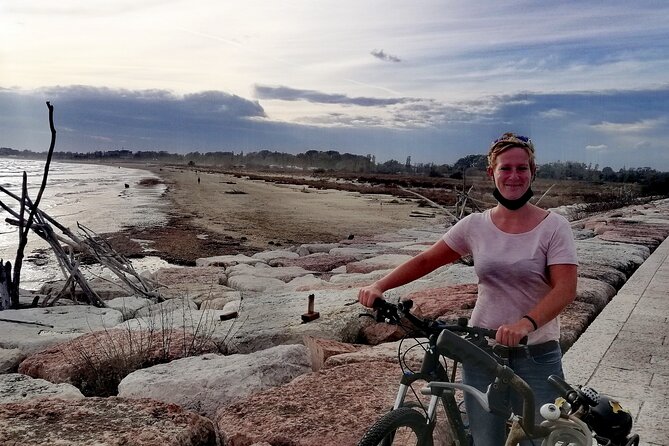
After the film-linked stops, you head to Murazzi. This is a scenic ride following the Adriatic Sea along the Murazzi, an 18th-century engineering work designed to keep high seas from crashing into the lagoon.
What makes this stop smart is that it’s practical history. You’ll see how something built for survival and safety becomes part of everyday scenery. It’s not just “old walls.” It’s the reason Lido’s coastal structure works as it does.
And the route angle matters. You’re on a bike, moving along the sea edge, so you get a long view rather than a quick look from a crowded footpath. That makes the Murazzi feel like a real part of the island’s system.
Alberoni dunes and the quiet beach feel at Oasi delle Dune
Next is L’Oasi delle Dune Alberoni. This is where the island turns wild again. You bike toward Alberoni’s natural beach, which includes a maritime pine forest sloping down to some of Lido’s most scenic, less-touristy stretches.
The dune fields are known for their poetry-like vibe. On windy days, you may even spot a few kite surfers or windsurfers. Often, though, the beach is nearly deserted except for marine birds and the occasional kite.
This stop is valuable because it gives you a break from “Venice center mode.” You get sea, sand, birds, and the feeling that you’re on the same island but in a completely different world. It’s a reminder that Venice is not only canals and grand buildings.
Malamocco: fisherman canals and the small-Venice scale
Then you enter Malamocco, a small fisherman village. The route includes crossing Ponte di Borgo and then exploring canals and calli.
This part is about scale. Compared with Venice proper, Malamocco feels more manageable and less overwhelming. You can see just a few churches and even a Gothic palazzo, a kind of smaller Venice condensed into a more local rhythm.
The guide helps you notice what you’d otherwise gloss over from the bike. After a few stops focused on tourism and big landmarks, Malamocco gives you grounded context: people still live here, work here, and move through these streets as daily life, not as a movie set.
Poveglia and Lazzaretto Vecchio: the isolation islands
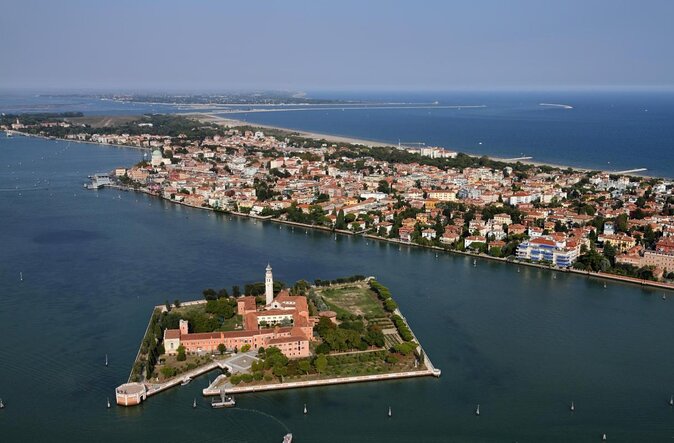
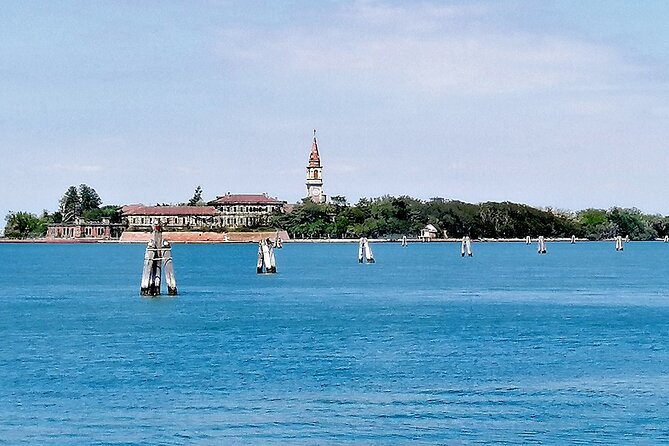
Now the tour shifts tone. You ride along the lagoon side with views of Lazzaretto Vecchio and you reach Poveglia.
Poveglia has a heavy reputation. From 1776 it served as a quarantine station for those suffering plague and other diseases. Later it was used as a mental hospital, and it closed in 1968. It’s frequently featured in paranormal shows, but even without that pop-culture angle, the place feels clearly built for separation.
Your next stop is Lazzaretto Vecchio. This island housed a hospital between 1403 and 1630, with care during plague epidemics, and later it functioned as a leprosarium. Eventually it also served as a military post.
I like pairing Poveglia and Lazzaretto Vecchio back-to-back. You start to see a bigger pattern: the Venetian lagoon system has always included islands designed for handling danger, disease, and separation. The bike route keeps it from feeling like a single grim stop. It becomes a guided thread across the lagoon.
San Lazzaro degli Armeni: a monastery island in the lagoon
Then you continue to San Lazzaro degli Armeni. This is another lagoon island with a monastery belonging to the Mekhitarists, an Armenian Catholic congregation, since 1717.
This is a useful counterpoint after the isolation islands. It’s still part of the lagoon’s story of institutions and community life, but the tone is different. It helps you see the lagoon not only as a barrier, but as a place where faith, culture, and identity took root.
Grande Albergo Ausonia Hungaria: tiles, luxury, and the return of style
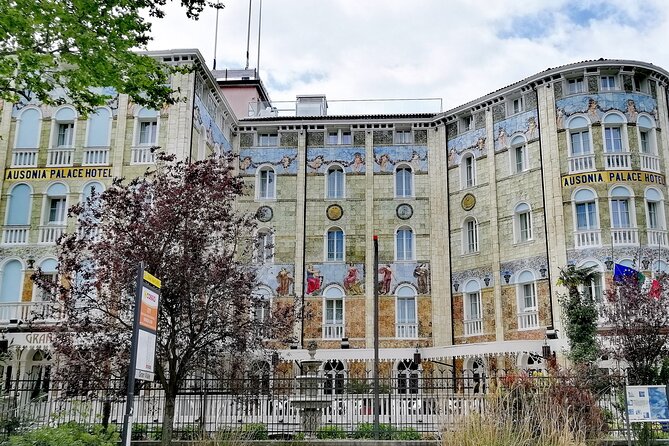
One more notable stop is Grande Albergo Ausonia Hungaria, also known as Hotel Ausonia & Hungaria (1913). It’s admired for its ceramic tile facade, which has been recently renovated.
This is where the tour starts to feel like a loop back into Lido’s classic elegance. After the cemetery and church, after beaches and villages, you end up at a hotel that looks like it belongs to the same era as the other luxury buildings you’ve been seeing along the way.
It’s a nice ending note because it ties the route together. Lido is a place where nature and architecture keep swapping roles.
What the ride feels like: pacing, group size, and practical comfort
This is a moderate physical fitness tour. You’re biking for about 4 hours and 30 minutes on Lido, with short breaks at each stop. It’s not described as a hardcore workout, and the bike options include e-bikes and fat bikes, which makes the experience more flexible for different riders.
The small group size, up to 10 travelers, is a big deal. It keeps the pace human, and it makes it easier for the guide to adjust. One solid review note: the guide adjusted to different biking abilities without making anyone feel slow or rushed.
Timing is also built into the experience. Each stop is short, usually around 15 minutes, so you’re moving through a full island arc rather than lingering too long at any one point. That structure keeps the day from getting heavy, especially if you’re coming from central Venice.
Price and value: what $203.50 really buys you
The tour is listed at $203.50 per person, and that cost is for the guided experience. Bike use is not included, but bike rental is organized for you if needed, and pricing depends on which bike you choose (for example, city bike 10 euros, tandem 20 euros, e-bike 20 euros, fat bike 18 euros, e-fat bike 30 euros).
So the value math is simple:
- You’re paying for a local interpretive guide plus the route planning that gets you across Lido effectively.
- You’re paying for a small-group experience.
- You’re paying for help choosing the bike that fits your comfort.
In one recent group, a standard rental came to about 12 euros per person, but your exact total will depend on what you pick. If you want the easiest ride over sandy or rough patches, a fat bike or wider-tire option might be worth it even if you’re not thinking about comfort today.
If you were doing this route on your own, you’d spend extra time figuring out where to go, what buildings matter, and why the islands across the lagoon are connected. Here, that context comes with the ride.
Who this tour suits best
This is ideal if you want a break from the busiest Venice streets and you like seeing multiple sides of a place in one day.
You’ll be a good fit if:
- You’re comfortable biking at a moderate pace for a few hours
- You want film festival context without having to be there during premiere week
- You like nature stops, beaches, and small local villages as much as famous architecture
- You enjoy guided storytelling, especially around cemetery and lagoon islands
If you hate any chance of uneven path surfaces, you should choose a wider-tire bike option and be ready for some brief walking in sandy areas.
Should you book the Lido Bike Tour with Valerio Coppo?
I’d book it if you want an efficient, guided way to see Lido as a real island, not just a ferry stop. The combination of film-linked landmarks, quieter nature sections, and lagoon islands like Poveglia makes it feel like a complete arc across the peninsula of Venice’s world.
Skip it only if you want a purely leisurely beach day with no historical stops, or if you’re not comfortable with biking for about 4.5 hours even at a moderate level. Also, factor in that bike rental is extra, so pick the bike type that matches your comfort.
Bottom line: if you want Venice from a different angle, where biking actually changes what you notice, this tour is a strong choice.
FAQ
Where does the tour start?
It starts at Santa Maria Elisabetta, 30126 Venice, Metropolitan City of Venice, Italy.
How long is the Lido Bike Tour?
The duration is about 4 hours and 30 minutes.
What’s the bike situation on this tour?
Bike use is not included. You can choose a bike type, and the rental bike is organized for you (city bike, tandem, e-bike, fat bike, and e-fat bike options are listed).
Are tickets included for the stops?
Admission tickets are listed as free for the stops on this tour.
What’s included in the price besides the tour itself?
Included items are the nature and interpretive guide and tour leader, plus the organization and booking of rental bikes if needed.
How big is the group?
The tour has a maximum of 10 travelers.
What language is the tour offered in?
It is offered in English.
What fitness level do I need?
The tour is described as suitable for travelers with a moderate physical fitness level.
Does weather matter?
Yes. The experience requires good weather, and if it’s canceled due to poor weather, you’ll be offered a different date or a full refund.
Is there a mobile ticket?
Yes, the tour includes a mobile ticket.
More Cycling Tours in Venice


More Tours in Venice
More Tour Reviews in Venice

Not for you? Here's more nearby things to do in Venice we have reviewed
Cycling Tours, compared.
 ★ 4.7Full Day Bike RentalFrom $1639 reviews
 ★ 5.0Bike rental in VeniceFrom $2935 reviews
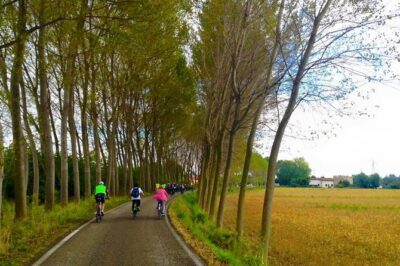 ★ 5.0Venice Countryside Bike TourFrom $10423 reviews
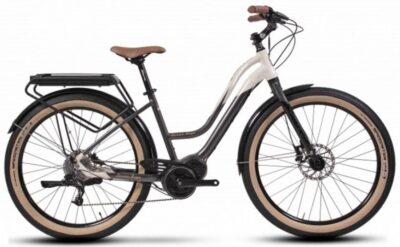 ★ 4.5Venice E-bike RentalFrom $3120 reviews
 ★ 5.0Sant’Erasmo Bike Tour in Venice’s Green IslandFrom $20318 reviews
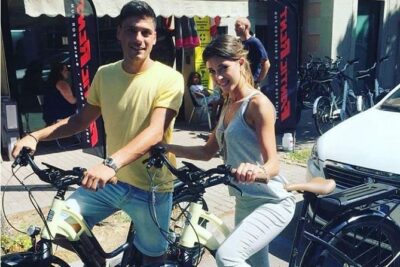 ★ 4.0Full Day Venice E-Bike RentalFrom $3013 reviews
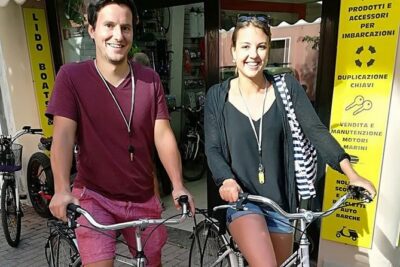 ★ 5.0Full Day Venice Bike RentalFrom $1513 reviews
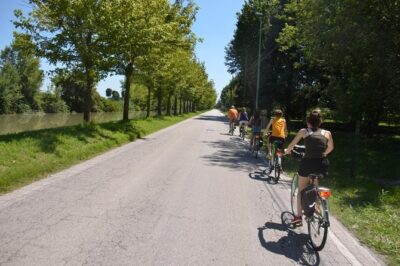 ★ 5.0Riviera del Brenta Bike TourFrom $8313 reviews
Browse the lists this tour appears in